
Perkins Engine Generator Exhaust Silencer
Precision Engineered for Perkins 400, 1100, 2000 & 4000 Series Diesel Generators
Bhavani Engineering manufactures high-performance industrial generator exhaust silencers custom-built for Perkins diesel engines from 10 kVA to 2500+ kVA. Every silencer is engineered to achieve superior acoustic attenuation while strictly preserving Perkins exhaust backpressure limits.
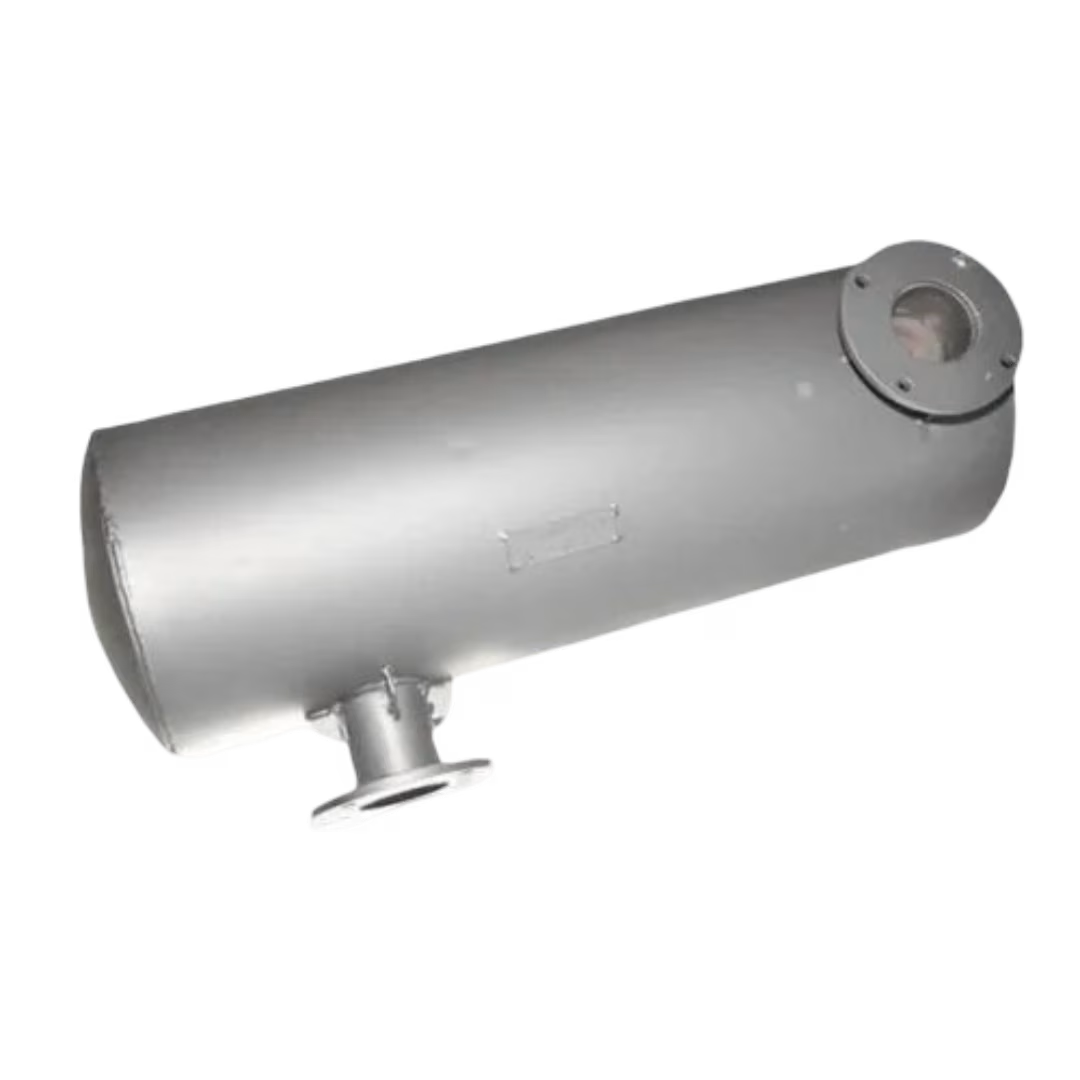
Individually designed for backpressure limits, thermal expansion, and noise attenuation.
Silencer Systems for Perkins Engine Series
Each engine series has distinct displacement, exhaust mass flow rate, and backpressure tolerances. We customize inlet/outlet geometries, shell diameters, and internal baffles accordingly.
Perkins 400 Series
10 kVA – 50 kVACompact, naturally aspirated or turbocharged engines typically housed in tight acoustic canopies for telecommunications, light commercial, and residential standby power. Requires compact cylindrical silencer bodies with minimal external radiation.
Perkins 1100 Series
30 kVA – 250 kVAThe primary workhorse engines powering mid-range industrial and commercial diesel generators (e.g. 1103, 1104, 1106). Requires combination reactive-absorptive chambers to suppress low-frequency rumble while keeping total system backpressure well below 8 kPa.
Perkins 1200 & 1500 Series
150 kVA – 350 kVAAdvanced electronically controlled engines engineered for demanding operational cycles. Tight backpressure envelopes demand aerodynamic diffuser geometry to prevent thermal accumulation and maintain turbocharger responsiveness.
Perkins 2000 Series
350 kVA – 750 kVAHeavy-duty prime and standby power generation units with high exhaust mass flow rates (e.g. 2206, 2506, 2806). Heavy-gauge steel casing prevents shell vibration and low-frequency break-out noise across large engine rooms.
Perkins 4000 Series (In-Line)
800 kVA – 1000 kVAEngineered for continuous prime base-load and critical standby infrastructure. High exhaust gas temperatures (up to 550°C) require dedicated thermal relief provisions, thick acoustic mineral packings, and reinforced end-caps.
Perkins 4000 Series (V-Engine)
1250 kVA – 2500+ kVAMassive multi-turbocharged V-configuration powerhouses. We manufacture dual-inlet silencers or dual-train symmetrical silencer banks with equalized backpressures across both cylinder banks to protect turbochargers from uneven loading.
Acoustic Tuning & Backpressure Management for Perkins Gensets
A generator exhaust silencer for a Perkins engine must perform two competing functions: dissipate immense acoustic energy without restricting the engine's exhaust gas expulsion. Our engineering team calculates exact pressure drops to match Perkins engine performance curves.
Calibrated Pressure Drop Under Perkins Tolerances
Perkins technical data sheets typically specify maximum allowable exhaust backpressure between 5.0 and 10.0 kPa depending on the engine series and aspiration. Our silencers are modeled so the internal pressure drop stays strictly within 1.8 to 2.8 kPa, leaving ample margin for long stack runs, elbows, and thermal expansion joints.
Low-Frequency Exhaust Pulse Cancellation
Perkins multi-cylinder engines generate heavy low-frequency pressure pulsations at combustion firing frequencies (typically 50 Hz to 125 Hz). Our reactive internal chambers use tuned Helmholtz resonators and perforated expansion tubes to reflect and attenuate low pulses before they escape the tailpipe.
Dual-Inlet Flow Balancing on V-Engines (4008/4012/4016)
For large V-configured Perkins power plants with twin or quad turbochargers, unbalanced exhaust piping causes differing backpressures on left and right cylinder banks. We engineer dual-inlet silencers with balanced internal flow plenums that equalize backpressure to within ±0.2 kPa.
Decoupling Thermal & Vibrational Stresses
Perkins turbocharger cast-iron housings must never carry the physical weight or thermal expansion load of an exhaust silencer. We engineer complete exhaust packages including high-flexibility stainless steel 304/321 expansion bellows that absorb up to 50 mm of axial and lateral expansion.
Crucial Rule: Do Not Oversize or Undersize Silencer Internal Velocity
Undersizing the internal pipe diameter causes severe backpressure and high-velocity gas turbulence ('jet noise'). Oversizing excessively can reduce the sound wave velocity through dissipative acoustic liners, compromising high-frequency noise absorption. Bhavani Engineering optimizes internal gas velocities between 25 and 40 m/s for Perkins applications.
Key Technical Parameters
* Exact backpressure, exhaust gas flow rate (m³/min), and maximum gas velocity must be validated against the specific engine technical data sheet. Bhavani Engineering provides certified backpressure calculation reports with every custom build.
Need a Backpressure Audit?
Share your generator model, exhaust pipe length, number of elbows, and target dBA reduction.
Submit Engine Specs for AuditNoise Reduction Grades & Insertion Loss
We manufacture three primary silencer grades for Perkins generators, balancing acoustic silencing performance against permissible backpressure limits.
| Silencer Grade | Insertion Loss | Residual Sound at 1m | Typical Applications | Internal Geometry |
|---|---|---|---|---|
| Industrial Grade | 15 – 20 dB(A) | Approx. 85 – 90 dB(A) at 1m | Remote industrial zones, quarries, open factories, and utility substations. | Single or dual-chamber reactive expansion with primary perforated baffle tubes. |
| Residential Grade | 25 – 30 dB(A) | Approx. 75 dB(A) at 1m (In Enclosure) | Standard urban commercial installations, office complexes, schools, and CPCB IV+ compliance. | Combined reactive-absorptive chambers with high-density rockwool acoustic packing. |
| Critical / Hospital Grade | 35 – 45+ dB(A) | Below 65 – 70 dB(A) at 1m | Healthcare facilities, 24/7 data centers, premium hotels, and noise-restricted residential areas. | Multi-stage reactive chambers + dense dissipative absorptive section with stainless wire-mesh barriers. |
* Residual sound levels assume installation within an acoustic enclosure designed to meet Central Pollution Control Board (CPCB) standards of 75 dB(A) at 1 metre.
Manufacturing Specifications & Metallurgy
Built at our facility in Bakrol/Narol, Ahmedabad, utilizing high-grade metallurgy, precision automated welding, and heat-resistant thermal coatings.
Explore Related Noise Control Solutions
Bhavani Engineering manufactures full-spectrum industrial silencers, soundproof acoustic enclosures, and custom exhaust ducting for all major generator brands across India.
Volvo Penta Generator Silencers
Engineered specifically for Volvo TAD series with strict 5.0 kPa backpressure threshold.
Generator Silencer Manufacturer India
National manufacturing overview, CPCB IV+ compliance, and DG set noise attenuation systems.
DG Set Silencer Supplier
Fast-track supply for generator OEMs, facility engineers, and turnkey electrical contractors.
Industrial Exhaust Silencer
Comprehensive acoustic solutions for blowers, compressors, gas engines, and process exhausts.
Frequently Asked Questions: Perkins Silencers
Clear answers to backpressure calculations, CPCB IV+ compliance, manufacturing timelines, and custom flange configurations.
QHow do you calculate backpressure for a custom Perkins generator silencer?
We calculate exhaust system backpressure using the Darcy-Weisbach and ASHRAE fluid dynamics formulas, utilizing your specific Perkins engine model's rated exhaust gas mass flow rate (kg/min or m³/min) and temperature (typically 450°C–550°C). We calculate the pressure drop across straight pipe runs, elbows, flexible bellows, and our silencer body to ensure the total backpressure remains below the maximum limit specified in your engine's technical data sheet.
QCan your silencers help my Perkins generator meet CPCB IV+ noise regulations?
Yes. In India, CPCB IV+ norms mandate noise levels not exceeding 75 dB(A) at 1 metre for DG sets up to 1000 kVA. When paired with an appropriately designed acoustic canopy, our Residential Grade (25–30 dBA reduction) and Critical Grade (35–45+ dBA reduction) silencers ensure full compliance with regulatory noise limits.
QDo you supply dual-inlet silencers for Perkins V-type engines (4008, 4012, 4016)?
Yes, we regularly fabricate custom dual-inlet silencers for V8, V12, and V16 Perkins engines. These silencers incorporate twin inlets tailored to match the exhaust outlets of both turbochargers, with internal flow balancing to ensure symmetric backpressure across both cylinder banks.
QWhat information is needed to get a quotation for a replacement Perkins silencer?
To provide an accurate engineering proposal and quote, please share: 1) Perkins engine model or kVA rating, 2) Existing exhaust pipe diameter, 3) Desired inlet/outlet orientation (e.g., end-in side-out, side-in end-out), 4) Required noise reduction grade (Industrial, Residential, or Hospital), and 5) Any spatial constraints within the canopy or plant room.
QCan you manufacture silencers in Stainless Steel (SS 304 or SS 316)?
Yes. While standard industrial silencers are fabricated from heavy-gauge IS 2062 mild steel with high-temperature coatings, we also fabricate silencers entirely from SS 304 or SS 316 for marine environments, coastal zones, chemical processing plants, and food-grade facilities.
QDo you supply Perkins generator silencers across India from Ahmedabad?
Yes. From our manufacturing facility in Ahmedabad, Gujarat, we supply custom and standard generator silencers across India, including industrial hubs like Mumbai, Pune, Delhi NCR, Bengaluru, Chennai, Hyderabad, and Kolkata.
Ready to Upgrade Your Industrial Noise Control?
Get a custom quote for your generator set silencers or exhaust systems today. Precision engineering meets rapid delivery.